As of May 25, 2026, I am retired. I was a finance professor for 41 years before retiring (now emeritus). My interests include how we can optimally use data to make decisions. Naturally a current concern is asset management in retirement, as well as financial management in retirement more broadly.
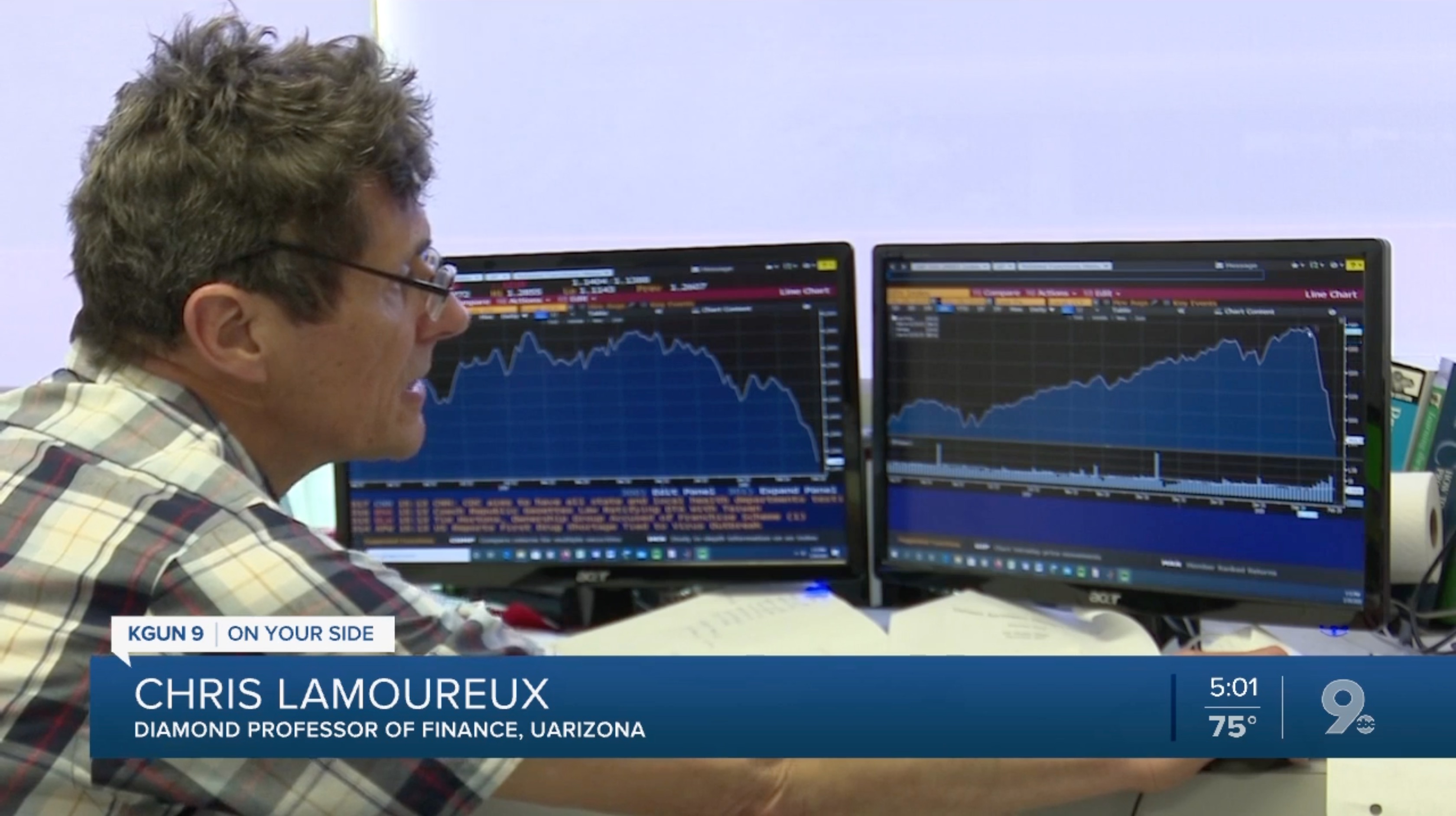
The screen shot above was taken in March 2020, in the early days of the Covid-19 pandemic in my office in McClelland Hall. The Bloomberg screens depict the extreme market reactions to the pandemic's onset. I always enjoyed talking with the media about financial markets, unforunately they mostly sought my perspective when the market was in some crisis or another. Over my professorial career that includes October 1987 and the meme-stock era of 2022.
My most recent and current favorite paper. You know your decision problem and you have data. Skip the intermediate step of modeling the data ganerating process and update your decision using the data. I was inspired by Bissiri, Holmes, and Walker's 2016 JRSSB "A General Framework for Updating Belief Distributions," which is a marvelous paper.
This is a machine learning approach to Brandt, Santa-Clara and Valkanov's brilliant parametric portfolio algorithm. Here we examine and manage estimation risk in the absence of a likelihood using out of sample validation (regularization).
This is my evolution as a Bayesian. This was motivated by Chris Sims' critiques of unit root tests, and the beauty of Bayesian data analysis. Usually we characterize the data through the lens of a model. If we're not careful, the model may overpower the data.
I was always intrigued by trading volume, as reflected in some of my earliest papers. I looked at stock splits in one of my earliest post-dissertation papers, and examined how trading volume behaved. I thought to link the fact that return variance goes up after a split to tax-timing options.
Spreadsheets, datasets, and teaching materials, freely available for research and classroom use.
Black-Scholes and binomial models with sensitivity analysis. Excel.
Spreadsheet tool for fitting yield curves from Treasury data.
Course notes from Arizona PhD-level asset pricing seminar.